
Signs Your Roof Has Hail Damage (With Photos)
Hail damage is the most misidentified roofing problem in the country. Some of it looks dramatic and turns out to be cosmetic. Some of it looks like nothing and turns out to be a totaled roof. The difference matters — for your insurance settlement, for your warranty, and for how long your roof actually lasts after the storm passes.
This is a visual guide to the signs of roof hail damage: what bruising, granule loss, and dent patterns look like on the common roof types, what you can assess from the ground, and what only a trained inspector with proper roof access can document. It draws on 30+ years of combined Quest Exteriors roofing and insurance-industry experience documenting hail claims across the country.
What hail damage looks like on asphalt shingles
Architectural asphalt shingles — the most common residential roofing material — show hail damage as round, dark bruises between 1/4 inch and 1 inch in diameter. The dark color is the asphalt mat showing through where the protective ceramic granules have been dislodged. The pattern is random across each slope, not in lines or rows — random distribution is one of the key signals adjusters look for to confirm hail vs. other damage causes.
Severe impacts produce three distinct signatures that experienced inspectors look for:
- Granule loss patches — round areas where ceramic granules are missing, exposing the dark mat underneath
- Soft bruising — when pressed gently with a thumb, the impacted area feels soft or spongy compared to surrounding shingle (indicates mat fracture)
- Mat fractures — visible cracking in the asphalt mat, sometimes with the felt backing visible through the impact
- Disengaged or torn shingle tabs — wind plus hail can lift or tear individual tabs, leaving the under-shingle exposed
Lighter impacts may show only as granule-loss patches without visible bruising. These count as legitimate damage but require a trained eye to identify and document at scale across multiple slopes.
What hail damage looks like on metal roofs
Metal roofs — standing-seam, stone-coated steel, corrugated panels — show hail damage as dents. Dents range from barely perceptible dimples to deep, dish-shaped impacts. Severity matters because:
- Shallow dents are typically cosmetic and excluded from coverage on policies with cosmetic-damage endorsements
- Deep dents can compromise the paint or coating system, exposing the substrate to corrosion over time
- Dents at seams or flashing can affect water management and warrant repair regardless of cosmetic concerns
- Stone-coated steel can lose surface granules in patterns similar to asphalt, in addition to substrate dents
Reading your policy declarations page is the critical first step before filing a metal-roof hail claim. If the policy includes a cosmetic damage exclusion, dent-only claims will be denied — and a denial on your record is worse than no claim at all.
Gutter, soft-metal, and decking damage
Hail damage rarely affects only the roof field. A complete inspection documents the full hail-damage signature across the property:
- Aluminum gutters and downspouts — visible dents at multiple locations around the perimeter (an easy ground-level signal)
- Gutter screens or leaf guards — punched, dented, or torn at impact points
- Soft metals on the roof — vent caps, plumbing flashings, chimney flashings show dents that confirm hail severity
- HVAC condenser fins — flattened against the unit on outdoor AC equipment (a strong corroborating signal)
- Skylights and solar tubes — cracked domes, dented frames, or shattered glazing
- Deck damage — soft spots discovered underneath shingles during tear-off, often indicating multi-event accumulated damage or pre-existing rot worsened by the latest storm
Soft spots on the decking are the kind of damage no one sees from the ground or from a quick walk. They're discovered during tear-off and become legitimate supplement items if documented properly to the carrier.
What you can see from the ground (and what you can't)
We don't recommend climbing your roof after a storm. Roofs are slippery, hot, structurally compromised, and insurance carriers don't accept homeowner-provided roof photos as primary evidence anyway. But you can identify likely damage from ground level by checking:
- Gutter dents at multiple locations around the perimeter
- Granules accumulating in downspout splash blocks (look like coarse black sand)
- Dents on aluminum patio furniture, mailboxes, or other soft-metal items in the yard
- Condition of outdoor AC condenser fins (easy to spot)
- Damage on neighboring properties — hail tracks in streaks, so if neighbors had damage, you likely did too
- Recent vehicle damage to cars parked outside during the storm
What you can't see from the ground: actual shingle-level damage, soft mat bruising, granule-loss patches, soft-metal flashing dents, and the random-distribution pattern that confirms hail vs. other causes. Those require proper roof access — which is exactly what a professional inspection provides.
Why a professional inspection is non-negotiable
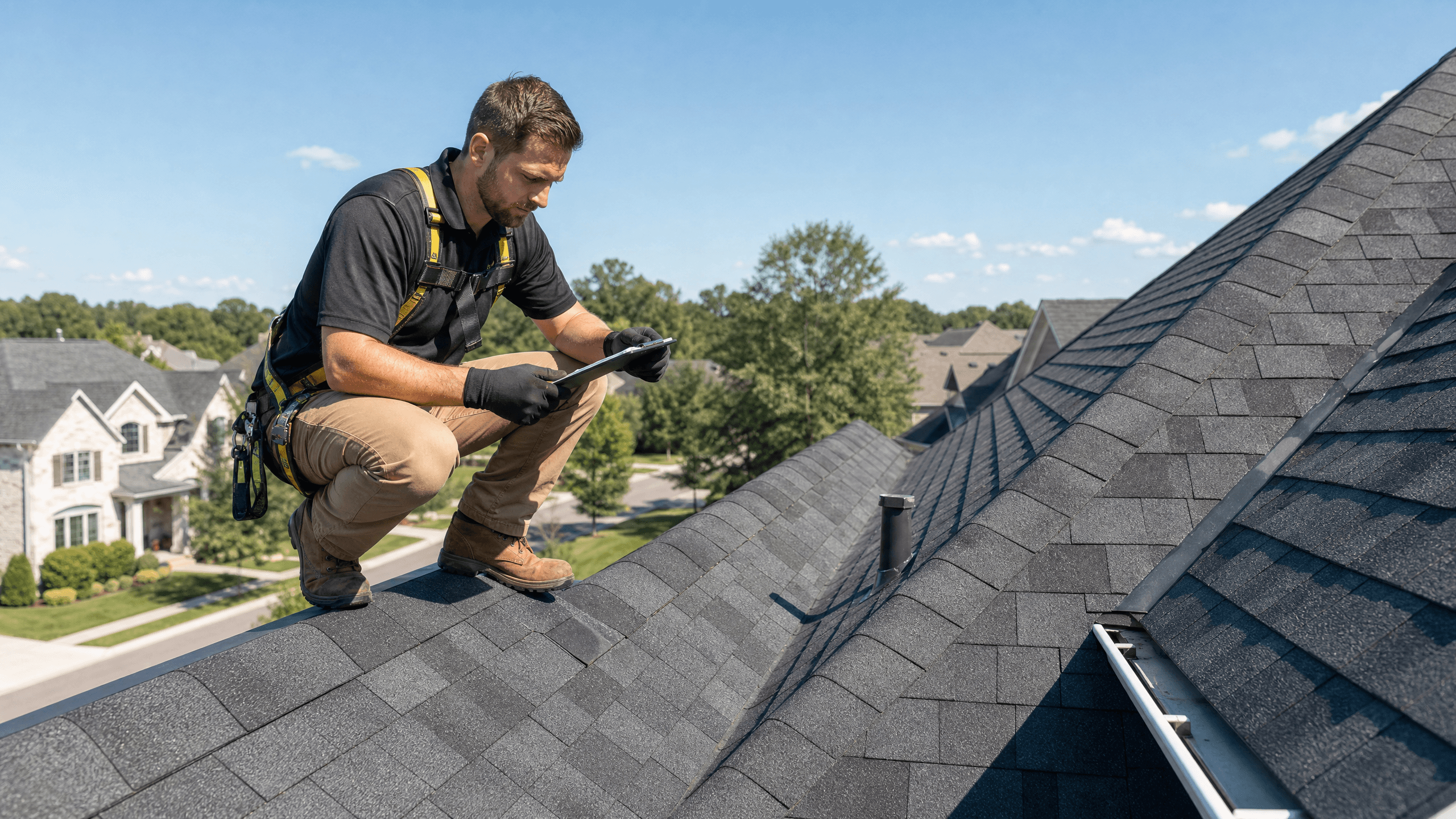
Insurance adjusters walk the roof. They don't accept homeowner ground photos as primary evidence. Your inspection has to match — which means a contractor walks every slope, photographs hits at three angles per slope, measures stone density per 10×10 grid, and produces a written report formatted to the standards major carriers actually approve.
An honest inspection costs nothing from a reputable roofing contractor. A good inspector will tell you honestly whether you have a claim-worthy event or not — and "you don't have damage" is a valid answer that saves you premium increases later. Far better than a contractor who pressures you into filing a claim that doesn't qualify.
How Quest documents damage for insurance
Quest Exteriors owner Cody Wood spent 16+ years on the insurance carrier side — including catastrophe and SIU adjusting through major hail and hurricane events — before founding Quest. That perspective shapes how we document every storm-damage inspection. Our scope packages include:
- Slope-by-slope photo documentation with reference markers showing impact density
- Hit-density mapping on a 10×10 grid per slope
- Soft-metal documentation (vent caps, plumbing flashings, chimney flashings)
- Gutter and HVAC condenser fin documentation
- Matching analysis showing whether partial replacement is feasible
- Code-required upgrade list for your jurisdiction
- Written narrative formatted to the standards the major carriers accept without supplement
The documentation is what gets claims paid fairly the first time. More on the full claim-handling process at Insurance Claims Help, or book a free inspection and we'll walk you through whether your storm event is worth filing.
Manufacturer resources
The major shingle manufacturers publish their own guidance on what hail damage looks like and how it interacts with their warranties — useful background before an adjuster walks your roof:
- GAF — homeowner resources on storm and hail damage and impact-resistant shingle performance.
- Owens Corning Roofing — product and warranty pages for their hail-rated shingle lines.
- CertainTeed — shingle documentation and Class 4 impact-rated product specifications.